Why High-Quality Jewelry Photos Sell More
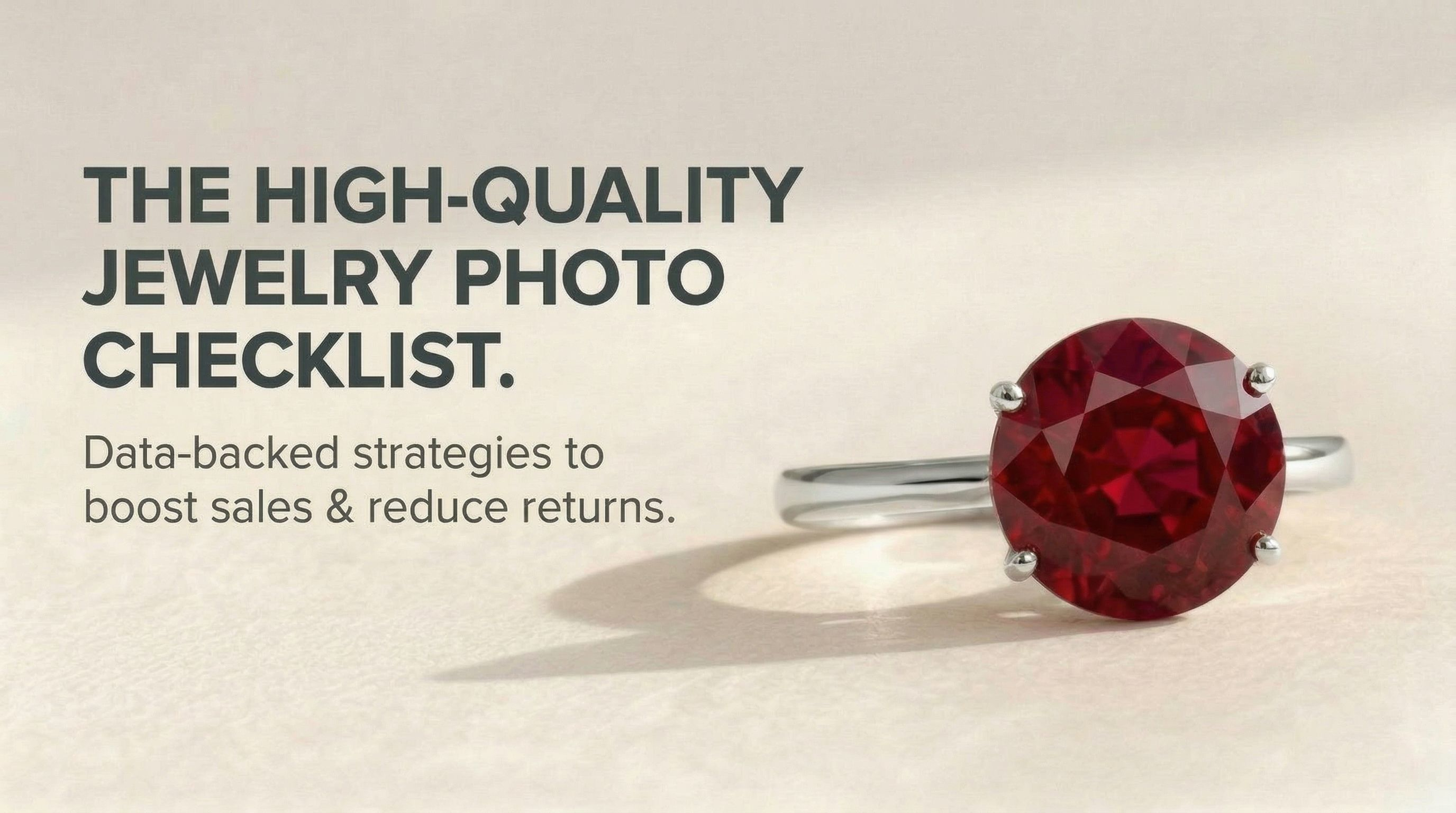
You can’t hand a customer your ring or pendant online. Your photos are the product in their hands. When they’re crisp, color-true, and informative, they do three things at once: grab attention, answer questions, and reduce risk. That’s why better jewelry photos lift clicks, conversions, and repeat sales.
Quick win: Want 3 pro photo tips each week? Get the tips by email →
The short version (what the data says)
- Shoppers explicitly want high-quality images and video when they evaluate products. It’s among the top content types people look for during consideration. Salsify
- On Amazon, zoomable images (≥1600 px) are recommended because zoom has been shown to help enhance sales. (And jewelry has some category-specific allowances, like necklaces that may touch the frame edge.) Jungle Scout
- Images must convey scale and detail: in usability testing, 42% of users try to gauge size from the product images - critical for stones, prongs, clasps, and chain thickness. Baymard Institute
- Speed matters (especially on mobile): improving mobile site speed by 0.1 s increased retail conversions by ~8% - images are the heaviest assets on most product pages. Think with Google
- Clear, accurate visuals help reduce returns. One large consumer study found “item not matching description” is a top driver of returns (56%) - often an imagery issue for color/finish/size. PowerReviews
- HBR perspective: HBR argues product pages must create experiences that convert (layout + content quality), and their coverage of image-powered search shows visuals can drive purchases - not just discovery. HBR
Why jewelry needs “extra” photo quality
Jewelry is small, reflective, and color-sensitive. The very things that make it beautiful — sparkle, facets, mirror-like metal — also make it hard to photograph. Your images must:
- Show fine detail (prong style, pavé quality, facet sharpness).
- Render color accurately (white/yellow/rose gold, gemstone hue/saturation).
- Communicate scale (mm dimensions, chain thickness, stone size on hand/neck).
- Minimize distracting reflections/dust that cheapen perceived quality.
Usability research backs this up: people rely on images to understand size and features — not just to “see something pretty.” Baymard Institute, Baymard Institute
How better photos turn into more sales
More clicks from search and category pages
On marketplaces, your main image is your ad. Clean background, true color, and controlled reflections raise CTR. Amazon’s own guidance emphasizes resolution for zoom, which “has been shown to help enhance sales.” Jewelry listings also get specific do/don’t rules — use them to your advantage. Jungle Scout
Higher add-to-cart on product pages
Shoppers expect multiple angles, macro detail, lifestyle/context shots, and ideally 360°/video. That mix builds confidence, especially for higher-ticket pieces. Salsify’s shopper research literally calls out high-quality images and videos as must-haves during consideration. Salsify
Fewer returns (and better reviews)
When images misrepresent color, finish, or scale, returns spike. “Item not matching description” remains a top return reason; jewelry is especially vulnerable if photos are off. Accurate imagery + clear sizing graphics = fewer disappointments and higher review averages over time. PowerReviews
Faster pages, more conversions
Large, unoptimized images slow pages — and slow pages lose sales. Google/Deloitte found 0.1s faster = ~8% more conversions for retail; compressing and modern formats (WebP/AVIF) keep quality while cutting weight. Think with Google
Try our solution: Use Poliro on your own photos — Upload & enhance for free →
How this pays for itself
Say your product page gets 2,000 visits/month, converts at 1.8%, AOV $180.
Baseline revenue: 2,000 × 1.8% × $180 = $6,480/mo.
Improve imagery, page speed and nudge conversion to 2.2% (plausible with better assets/zoom): $7,920/mo.
That’s +$1,440 per month from one SKU cluster — before counting fewer returns.
What industry leaders teach us
- James Allen: 360° HD + up to 40× magnification. Every diamond gets interactive 360° imagery so shoppers can inspect inclusions and scintillation — removing uncertainty and justifying price. Borrow: add macro/360 for hero SKUs. James Allen, James Allen
- Rare Carat: transparency via 360° videos across a huge catalog. They emphasize high-resolution 360° as table stakes for confidence (and even recommend 10× imagery before you buy). Borrow: make defect-revealing imagery a trust signal. Rare Carat, Rare Carat
- Zales: multiple angles + zoom and robust education. Product pages prominently feature hover-to-zoom and galleries; the Education hub reduces buyer uncertainty (metals, stones, care). Borrow: pair better images with education to answer pre-purchase questions. zales.com
You can borrow their tactics as these are already proven to work. It’s always smart to replicate what works before trying something new.
Summary
I recommend using the following overview as a sort of checklist for your jewelry product visuals:
Main (hero) image
- 2000×2000 px (or larger) on pure white; artifact-free edges; accurate white balance; dust removed; reflections controlled.
- For marketplaces, follow category rules (e.g., Amazon’s jewelry allowances) and enable zoom. Jungle Scout
Secondary images
- Macro detail (stone table/culet, prongs, hallmarks).
- In-scale shot next to a coin/ruler or with an on-model close-up to show size. Remember: 42% of users look to images for scale. Baymard Institute
- Lifestyle context (on hand/neck/ear) with consistent skin-tone rendering.
- Variations: metal color, gemstone options, chain lengths — label them in-image.
Motion
- 10-20s spin or 360° clip showing scintillation and fire (stones sell when they sparkle).
Technical quality
- True color (calibrated workflow), no color casts; controlled contrast on reflective metals; natural-looking shadows; consistent cropping.
- File optimization (modern formats, responsive sizes) for fast mobile load. Speed lifts conversions. Think with Google
Sources & further reading
- Harvard Business Review — How to Design Product Pages that Increase Online Sales; Picture This: Why Online Image Searches Drive Purchases. Harvard Business Review, Harvard Business Review
- Amazon Seller Central — Product image requirements; Jewelry image notes; zoom guidance. Amazon Seller Central, Amazon Seller Central
- Salsify, 2024 Consumer Research — shoppers want high-quality images and video on product pages. Salsify
- Amazon image requirements — zoom has been shown to help enhance sales; jewelry-specific rules noted. Jungle Scout
- Baymard Institute — 42% of users try to determine scale from images; product-image UX guidance. Baymard Institute
- Think with Google/Deloitte (Milliseconds Make Millions) — 0.1s faster mobile site → ~8% conversion lift for retail. Think with Google, Deloitte
- PowerReviews (2023) — “Item not matching description” (56%) is a top return reason; accurate visuals help. PowerReviews
- James Allen — 360° HD / 40× magnification. James Allen
- Rare Carat — 360° videos with magnification; guidance to view 10×/360 before buying. Rare Carat
Thanks for reading — questions or requests? Reply and I’ll add them to the next tip.
Ready to enhance your next jewelry photo?
Studio-quality results in seconds. Free to start. No card required.
One concise email. Unsubscribe anytime.
Related Articles
How to Add Sparkle to Jewelry Photos Without Faking the Stone
A practical protocol for enhancing jewelry sparkle while preserving facet patterns, stone identity, and product truth.

How to Export Jewelry Photos for Shopify, Etsy, and Amazon
A practical jewelry export matrix for choosing JPEG, PNG, or WebP without losing transparent edges, metal tone, gemstone detail, or marketplace compatibility.
How to Photograph Gemstones Before AI Enhancement
A practical six-frame source-photo protocol for preserving gemstone color, facets, inclusions, scale, and setting details before AI enhancement.